How we work Case studies About Insights Show us your process

Custom software for companies

Your business outgrew Excel.
We build the system that replaces it.

We build software for companies whose important processes still run on spreadsheets, email, chat threads and manual re-typing of data.

Instead of another tool your company has to adapt to, you get a system built around the way you actually work.

Send a spreadsheet, screenshots, a Loom or a short description of the process. We will tell you what is worth building, whether we are a good fit and what a sensible next step looks like.

Excel works. Until the company outgrows it.

Nobody decides to run a company on spreadsheets. It just happens: one file, then another, then an email with an attachment and one person who merges it all by hand.

01

The same data in several places

A spreadsheet, an inbox, the accounting system, sometimes a chat thread. Every re-entry is a chance to get it wrong.

02

One person knows how it really works

When they are on holiday or leave, the process slows down and the question comes back: how was this actually calculated?

03

Quotes and reports are made by hand

Every time from scratch, in the same file from two years ago, with formulas nobody wants to touch.

04

Everyone asks for status

Clients and staff keep asking for things the system should show on its own, without a phone call or an email.

Each of these costs a few hours every week and grows with the company. At some point hiring one more person stops solving it.

Case studies

Four processes that stopped being manual.

Each of these systems replaced specific work that used to happen in spreadsheets, inboxes and phone calls.

Cargonaut — platforma wyceny transportu

Cargonaut · transport and freight

Transport quoting: from hours to 30 seconds

Before

A dispatcher calculated every quote by hand: distance, rates, fuel surcharges. The answer reached the client after 24-48 hours, often once someone else had already taken the job.

System

A quoting engine calculating real routes across 27 EU countries, three pricing tiers, automatic vehicle sizing and ADR surcharges. Plus a lead pipeline, client portal, GPS tracking and an embeddable quoting widget for the carrier's own website.

Outcome

A quote in under 30 seconds instead of a dispatcher's day. The platform runs white-label, so the same process now serves other transport companies.

Full case study: Cargonaut
CzystePro — platforma audytów energetycznych

CzystePro · energy audits

Energy audits: from hours to minutes

Before

Advisors calculated audits in spreadsheets and assembled reports by hand. ISO 13790 compliance meant checking every number, and subsidy paperwork was re-typed separately.

System

An ISO 13790 calculation engine with Glaser analysis, a generator for PDF reports and offers, and document export into government subsidy programmes. Many advisors work in one platform, each on their own data.

Outcome

Over 200 advisors, more than 5,000 audits and 45M PLN in subsidies processed through the platform.

Full case study: CzystePro
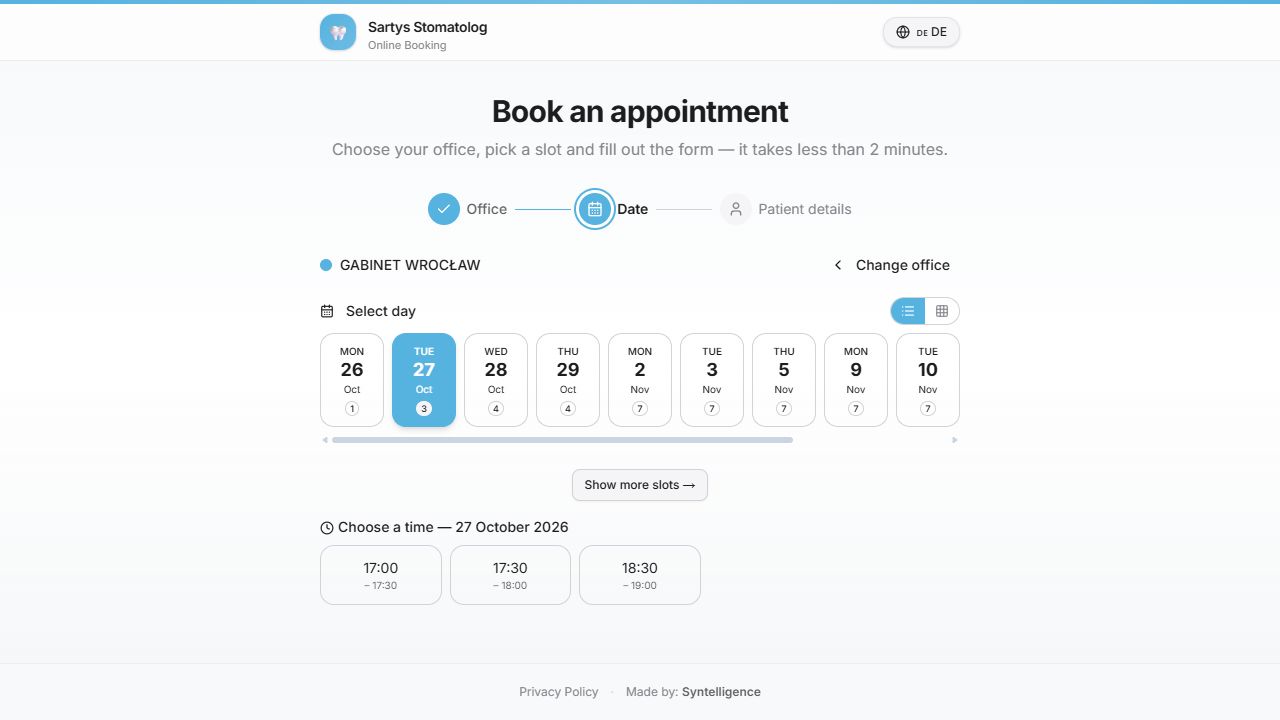
DentaBook — system rejestracji i kartoteki pacjentów

DentaBook · dental clinics

Booking and patient records in one place

Before

Office schedules, patient data and appointment confirmations lived apart: a calendar, a phone, paper. Booking took a conversation and treatment history was spread across several places.

System

A multi-office system with public booking without login, an anatomical dental chart, patient records, files and SMS. Each clinic's data is isolated at database level.

Outcome

Booking an appointment takes under two minutes and there is one patient record instead of several sources of truth. The system runs in production.

Full case study: DentaBook
Nowe Winiary — interactive floor plan with unit availability and an apartment list Nowe Winiary — apartment page 36/15 with size, status and a price enquiry
Picking a unit on the floor plan, and the apartment page — screenshots from the live implementation.

Nowe Winiary · real estate

56 apartments. One sales system.

Before

The apartment offer, the material, the statuses and the work of the sales office had to run as one coherent process rather than several independent parts of a website.

System

The sales platform for Building D: interactive floor and unit selection, 56 apartment pages with floor plans and room schedules, prices and statuses from a single database, filters saved in the URL, enquiries tied to a specific unit, and a panel for the sales office.

Outcome

The buyer and the sales office work from one source of data: the offer, the units, the statuses and the handling of interest are part of the same system.

How we work

From a manual process to a working system.

We repeat the same process on every project. We do not sell developer hours, we solve a specific operational problem.

01

We analyse the process

We take apart what you do by hand today: who, when, in which tool and how long it takes. You get a process map and a list of what is worth building first.

02

We design the solution

Scope of the first version, data model, integrations and a clickable prototype. You see how the system will work before any code exists.

03

We build the system

Weekly iterations on a staging environment. Every week there is something to click and comment on, so the direction gets corrected along the way, not at the end.

04

We roll it out

Data migration from spreadsheets, team training, production launch and support after go-live. The rollout ends when people actually work in the system.

The first working version usually takes 6-8 weeks from kick-off. Larger rollouts are split into stages, starting with the part of the process that costs the most time.

Fit

Who this is for, and who it is not.

We would rather say it upfront than waste your time and ours on a call.

Good fit

  • +The process matters to how the company runs, it is not a side convenience.
  • +The current solution is manual, scattered or held together by one person.
  • +The problem costs real time or money and you can put a number on it.
  • +You need a system shaped around your way of working, because off-the-shelf tools do not cover it.

We are not a good choice if

  • You are looking for a website for a few thousand zloty.
  • You need a few developer hours on an existing project.
  • You are picking a supplier on lowest price.
  • The project is a loose idea with no real business problem behind it.

Orders of magnitude

Custom software projects start at 30,000 PLN.

Rollouts covering a full operational process most often land between 60,000 and 150,000 PLN. We quote after analysing the process rather than from a price list, because only then is it clear what actually needs to be built.

How we deliver

You talk to the people who will build it.

The founder is directly accountable for the product architecture and the key decisions. Product, business and engineering decisions are made close to the build, so you get senior ownership without the cost and inertia of a large structure.

The founder owns the architecture

The product architecture and the key decisions sit directly with the founder. The project does not travel from a salesperson through an account manager to whichever team is free.

No broken telephone

No account manager between you and the person writing the code. Decisions do not get lost on the way.

A small team, seniors only

A small, experienced team runs the delivery, and we bring in specialists when the project calls for it. You are not paying for layers of coordination, or for anyone learning on your budget.

The project does not rest on one person

The architecture and the decisions are written down, and the code, the data and the access are yours from day one. You are buying a working system, not a dependency on somebody's calendar.

A prototype instead of a deck

You see the first version of the screens within days. It is easier to say "not like that" on a clickable prototype than on a slide.

A modern toolset

We use AI tooling where it genuinely speeds up building. The speed-up goes into quality and pace, not into the headcount on the project.

"I explained what I needed and Pawel came back with something better than I imagined. Our customers keep saying how smooth everything is now."

Jesper Melin · Google review

"Sharp and direct. He saved me time, money and a lot of unnecessary hassle by focusing on what actually matters."

Sanna Trollstierna · Google review

How we limit the risk

You do not have to take our word for it. You see a working version before you pay for the whole thing.

A system is a serious expense, so the most common question is not what it costs but what happens if it does not work out.

You pay for working stages.

The project is split into stages. You regularly see a working version on a test environment, so the direction can be corrected before correcting it gets expensive.

We do not leave the rollout to you.

If the process lives in Excel, CSV files, PDFs or several tools today, we help move the data across and get the system into the team's real work.

The code and the data are yours.

The repository, the database and the infrastructure are available to the client. We do not build a business on locking you out of your own system.

90 days of cover after launch.

We fix defects in the agreed scope for 90 days after the production launch at no extra charge. A new feature or a change of scope is not a defect, and we say so up front.

Show us the process you want to fix.

You do not need a specification or a ready idea for the solution. A spreadsheet, a few screenshots or three sentences about what you do by hand is enough.

01

You fill in the form and attach whatever material you have at hand.

02

We read it and send back an assessment: what is worth building and in what order.

03

If it makes sense on both sides, we book a call about scope and pricing.

Questions we hear most often

What does a system like this cost? +

Custom software projects start at 30,000 PLN. Implementations covering a complete operational process most often fall in the 60,000-150,000 PLN range. We give a specific number after analysing the process, because only then is it clear what needs to be built.

How long does it take to build? +

The first working version usually takes 6-8 weeks from kick-off. Bigger systems are built in stages, starting with the part of the process that costs the most time.

Who owns the code and the data? +

You do. The repository, the database and the infrastructure are yours. You can develop the system with someone else, although clients usually stay because we know their process.

We already have an ERP and a few other systems. +

We usually do not replace the ERP. We build the layer that connects what you already have and handles the process none of those systems covers. Integrations go through APIs, or file exchange where there is no API.

What happens after I send the form? +

We read your process description and the material you attached, then send back an assessment: what is worth building, where to start and what budget range makes sense. If we are not a good fit, we will say so directly.